
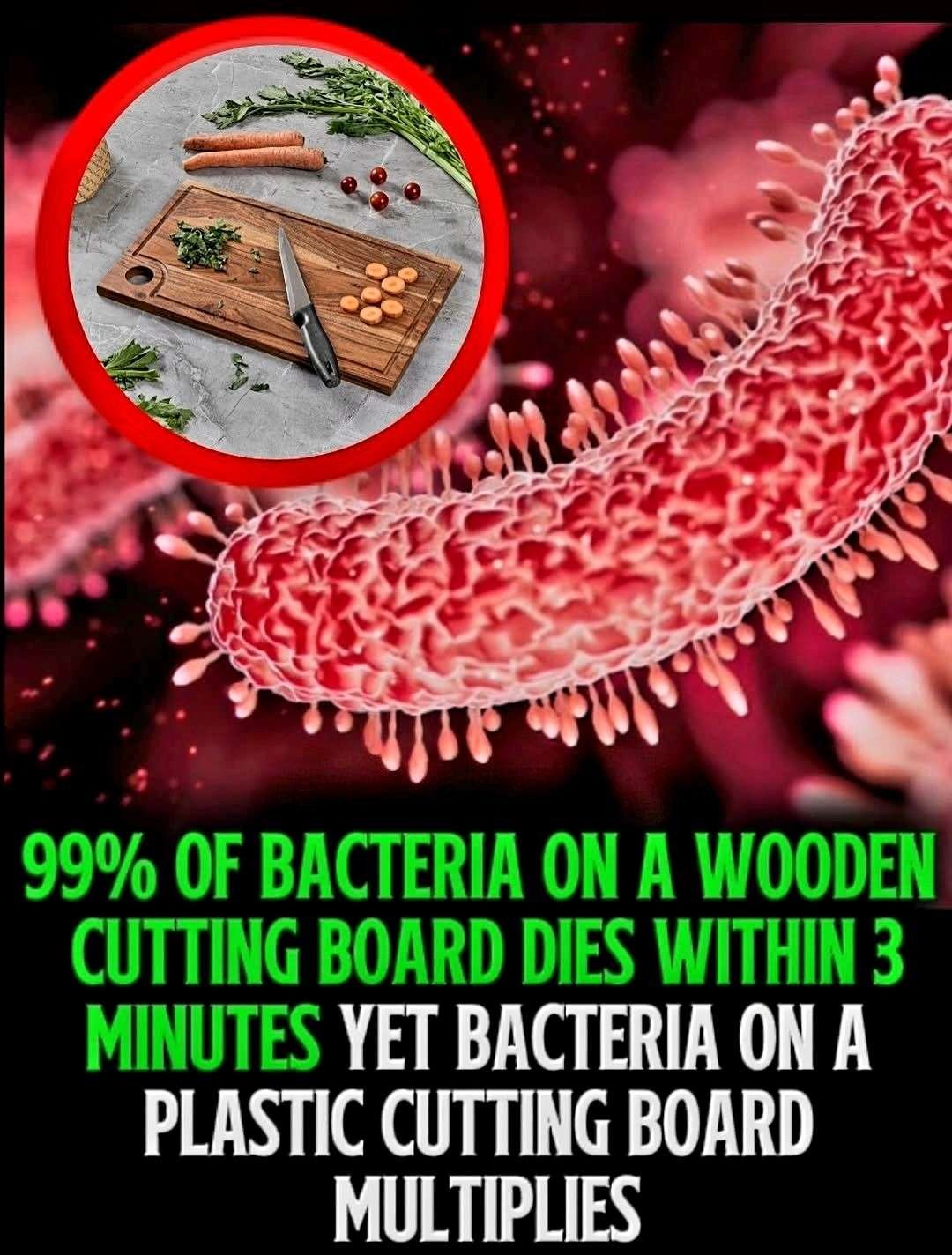
For years, plastic cutting boards have often been promoted as the more hygienic choice for the kitchen. The reasoning seems straightforward: plastic is nonporous, while wood is porous and can absorb moisture and bacteria.
But the science is more complicated.
Research has found that wooden cutting boards can sometimes harbor fewer recoverable bacteria than plastic boards, particularly after contamination has had time to enter the wood. At the same time, other research has shown that bacteria can become embedded in wood and that some wooden surfaces can be harder to clean thoroughly.
So, are wooden cutting boards actually safer?
The answer depends on the condition of the board, how it is cleaned, what foods are being prepared, and how it is used.
Why plastic cutting boards can become a problem
A new plastic cutting board has a major advantage: its surface is relatively smooth and nonporous, making it easier to wash and sanitize.
The problem develops with repeated use.
Every time a knife cuts into a plastic board, it can create small scratches and grooves. Over time, these cuts can become deep enough to trap food particles, moisture and microorganisms.
Research published in the Journal of Food Protection found that plastic boards with extensive knife scars were more difficult to clean manually, particularly when chicken fat and other food residues were present.
Another study examining household cutting boards found that worn boards could exhibit structures resembling biofilms, while plastic boards had higher counts of some groups of bacteria than wooden boards in that particular study.
This doesn’t mean that every scratched plastic board is dangerous. It means that wear matters.
The USDA specifically recommends replacing cutting boards once they become excessively worn or develop grooves that are difficult to clean.
What happens to bacteria on wood?
This is where things get interesting.
Wood is porous. When contaminated liquid enters the surface, some of it can be absorbed into the wood rather than remaining on the surface.
In a classic study comparing plastic and nine types of hardwood, researchers contaminated boards with organisms including E. coli, Listeria and Salmonella.
They found that bacteria were generally recovered in greater numbers from plastic than from wood. Clean wood rapidly absorbed the contaminated liquid, and bacteria often became difficult to recover from the surface within minutes.
Under some experimental conditions, bacterial numbers in wood were reduced by more than 98%, and sometimes more than 99.9%, over time.
That led the researchers to challenge the common assumption that plastic was automatically more sanitary than wood.
But there is an important caveat.
Absorbed bacteria are not necessarily dead bacteria.
Some research has demonstrated that bacteria can enter the microscopic structure of wood and remain viable there. One study found that bacteria could reside within the wood’s xylem structure and that wood could actually retain bacteria more strongly than plastic under certain conditions.
So the idea that wood simply “kills bacteria” is too simplistic.
What about biofilms?
A biofilm is a community of microorganisms attached to a surface and surrounded by a protective matrix.
Biofilms can make bacteria more difficult to remove and can contribute to persistent contamination.
Researchers have demonstrated that Salmonella can form biofilms on cutting-board materials, including both wood and plastic. In one study, bacteria associated with biofilms could still be recovered after washing.
This is important because it means the argument isn’t simply:
Plastic = bacteria
Wood = no bacteria
Both materials can become contaminated.
The bigger issue is whether the surface is cleanable and maintained properly.
Wood isn’t automatically safer
There are studies pointing in both directions.
A 1997 study comparing worn wood and plastic boards found that wooden surfaces could develop cracks capable of trapping bacteria. After standardized washing and sanitizing, residual contamination was sometimes detected on the wood surfaces but not the plastic surfaces in that experiment.
More recent household research has also found bacterial contamination on both types of boards. In a 2025 study of 100 household cutting boards, researchers detected Listeria monocytogenes and E. coli, with no significant difference between materials for those pathogens. Plastic boards did, however, have higher counts of some general bacterial groups.
That is why it would be misleading to say that wooden cutting boards are universally safer.
So why do some studies favor wood?
There are several possible explanations.
Wood has a complex cellular structure that can rapidly absorb contaminated liquids away from the surface. Once inside the material, bacteria may become less available for transfer back onto food.
Some types of wood may also have chemical properties that inhibit particular microorganisms.
But these effects vary according to the species of wood, moisture, contamination level, temperature, surface condition and cleaning method.
A recent study comparing sugar maple with HDPE plastic found that E. coli levels on maple decreased substantially over time, with lower detection than on HDPE in some experiments. The researchers suggested that wood’s hygienic properties deserve further consideration.
That doesn’t establish that every wooden board is safer than every plastic board.
It demonstrates that the traditional assumption that “plastic is always more hygienic because wood is porous” isn’t supported by all of the experimental evidence.
What does the USDA recommend?
The U.S. Department of Agriculture does not say that consumers must choose wood over plastic.
Instead, it says consumers can use either a wooden cutting board or a nonporous surface such as plastic.
The USDA notes that nonporous surfaces are easier to clean, but it also permits solid wood boards for food preparation.
The important recommendations are:
– Wash the board with hot, soapy water after use.
– Rinse it thoroughly.
– Allow it to dry completely.
– Sanitize when appropriate.
– Replace boards that become excessively worn.
– Use separate boards for raw meat and ready-to-eat foods when possible.
The last point may be more important than whether the board is wood or plastic.
The biggest risk may be cross-contamination
Imagine you cut raw chicken on a board.
Even if the board looks clean afterward, bacteria from the chicken may have contaminated the surface.
If you then use that same board to chop lettuce, tomatoes, fruit or other foods that won’t be cooked, bacteria can be transferred directly to food.
That’s why the USDA recommends considering one cutting board for fresh produce and bread and another for raw meat, poultry and seafood.
In other words:
A well-maintained plastic board used correctly can be safer than a neglected wooden board.
And a well-maintained wooden board can be perfectly appropriate for food preparation.
When should you replace a cutting board?
Don’t wait until a board looks disgusting.
Look for:
– Deep knife grooves
– Cracks
– Splits
– Areas that are difficult to scrub clean
– Warping
– Excessive surface wear
– Persistent food residue
The USDA specifically recommends replacing both plastic and wooden boards when they become excessively worn or develop hard-to-clean grooves.
So the idea that only plastic boards need replacing is incorrect.
What about wooden boards and dishwashers?
Care depends on the particular board.
The USDA states that solid wood cutting boards can be washed in a dishwasher, although laminated boards may crack or split.
Many wooden-board manufacturers nevertheless recommend hand washing because repeated exposure to water and heat can damage certain boards.
Always follow the manufacturer’s care instructions.
The bottom line
The viral statement that “wooden cutting boards are safer than plastic because bacteria die in wood” contains a kernel of truth, but it oversimplifies the science.
Research has repeatedly demonstrated that bacteria can behave differently on wood and plastic. Some experiments have found substantially lower recoverable bacterial levels on wood, while others have found that bacteria can remain embedded in wood and that wood may be more difficult to sanitize under certain conditions.
The most defensible conclusion is:
Neither wood nor plastic is automatically the safer cutting-board material.
A clean, well-maintained board is what matters most.
If you prefer wood, choose a solid, durable hardwood board and maintain it properly. If you prefer plastic, replace it when deep scratches and grooves make it difficult to clean.
And regardless of material, the most important habits are simple:
Clean it after every use.
Keep raw meat separate from ready-to-eat foods.
Sanitize when appropriate.
Let the board dry.
Replace it when it becomes excessively worn.
Those practices do far more to reduce foodborne-illness risk than simply choosing one material over another.One important correction to your original wording: “wooden boards are safer” is too absolute. The evidence supports saying that some studies have found lower bacterial recovery from wood than from plastic, while other studies demonstrate bacterial retention in wood. That distinction makes the article much more scientifically defensible.